
Low-cost data collection from remote offshore assets

Project Description Reliable data transfer enables remote operations and lower cost operations. This project explored the use of the Starlink network to reliably transmit data under different environmental conditions between two locations. The prototype demonstrated: the feasibility of low-cost alternative technologies to monitor remote assets (e.g. sensor, Raspberry Pi, Starlink and Cloud technologies); collect and […]
Quantifying Net Carbon Sequestration of Kelp Forests in WA
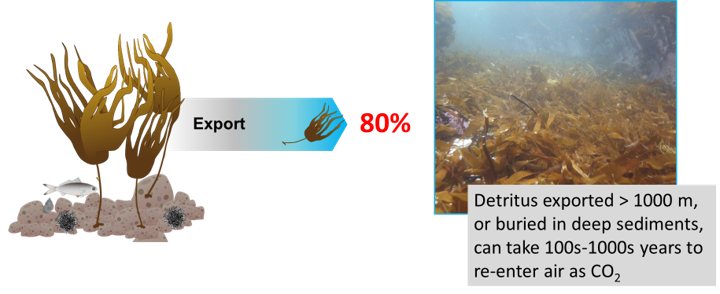
Project Description With the aim of identifying additional carbon sequestration opportunities for Woodside Energy, this project investigated natural processes which capture carbon in kelp. Firstly, this project revealed a significantly slower in situ decay rate of the dominant kelp species Ecklonia radiata compared to that of Scytothalia dorycarpa, a cooler water fucoid seaweed. We also […]
Well Cementing Data Analysis

Project Description During wellbore drilling and construction, cement is placed in annular spaces between the casings and rock formations exposed to the borehole. Cement is also widely used for well plugging-and abandonment (P&A). In both cases, the main purpose of cementing is to achieve zonal isolation, i.e., provide barriers against fluid seepage along the well […]
Cementing for Wells Plug and Abandonment

Project Description When a well reaches the end of its lifetime, it must be permanently plugged and abandoned (decommissioned). It is important to ensure that plugged wells do not leak after abandonment, as there could be several potential leak paths such as microannuli in plugged wells. To ensure well integrity after abandonment, permanent well barriers […]
Improved Current Forecasting

Project Description Accurate forecasts of surface currents are important for scheduling offshore activities but are not routinely available. In 2018, a framework was developed at UWA via the Shell Chair in Offshore Engineering to generate current forecasts based on the synthesis of classical tidal modelling with Bayesian modelling approaches. This project further developed this framework […]
Network of Floating Offshore Wind Turbines
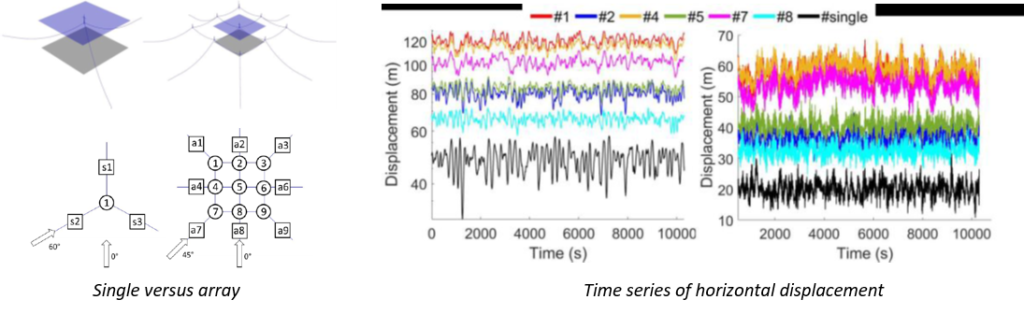
Project Description Floating offshore wind turbines are moored to the seabed in deep water. As water depths increase rapidly, anchoring individual turbines requires long length of anchor wire. In addition, some concepts consider shared anchors, which introduces challenging load cases – and potential reduction in holding capacity. Can we reduce cost through alternate mooring arrangements? […]
Neutralisation of Potential Energy in Christmas Tree Valves
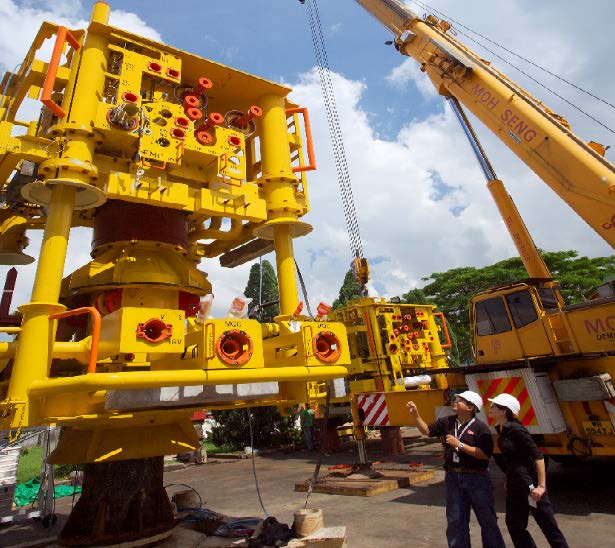
Project Description Submerged Christmas trees are used to control flow into and out of oil, gas, and water wells. They play the role of a pressure-containing interface through mechanisms of potential energy storage. However, these energy storage systems can become safety hazards during decommissioning. This study investigated the behaviour of Belleville springs used in subsea […]
THz for Plastics Characterisation
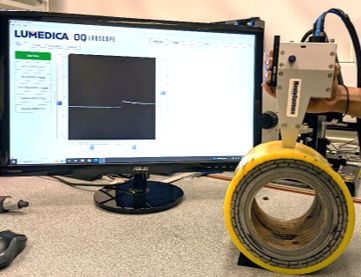
Project Description Terahertz (THz) pulsed spectroscopy and imaging lies between the infrared and microwave parts of the spectrum and has the unique ability to go penetrate not metallic materials like plastics. THz has already been adopted in the plastics manufacturing industry for quality control, as it can be used to determine material properties, thickness, and […]
Tidy Data for Effective Data Science – with Application to Flying Lead Reliability
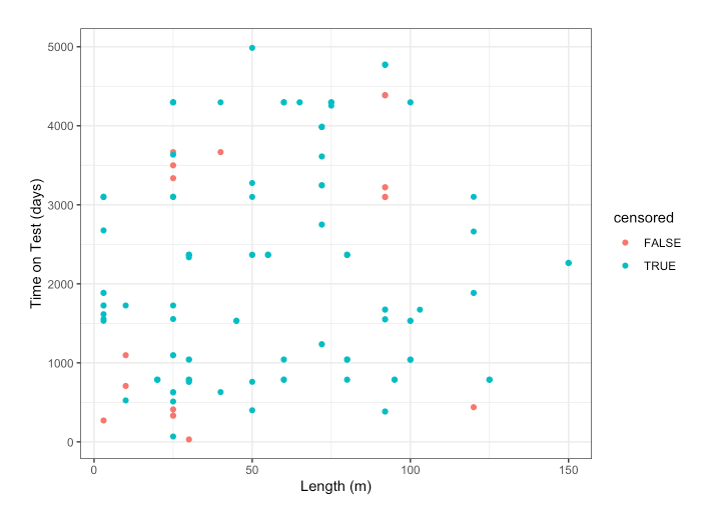
Project Description Data science is being increasingly acknowledged for its potential to aid decision making in engineering analysis. Particularly in the resources industries, there is potentially much to gain by increasing collaboration between data owners, who have significant application experience, and data analysts, who are able to implement modern data science techniques A Bayesian statistical […]
VibrioPET to Degrade Plastics in the Ocean
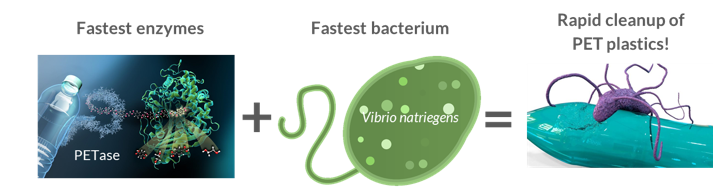
Project Description As part of the ongoing research to characterise organisms retrieved from Woodside’s Anti-Marine Growth Structure (“AMGS”), this prototype tested the assumption that the marine growth on the AMGS is the same marine growth that currently disables equipment such as underwater connectors. The project analysed underwater video footage showing Woodside’s subsea equipment that routinely […]